Sunday, March 3, 2013

Gettysburg


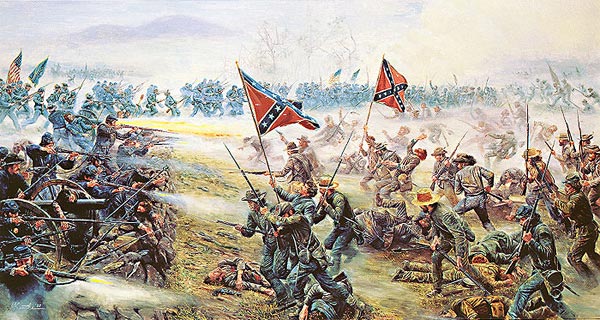
          The Battle of Gettysburg was a battle that lasted three days. It was fought in and near Gettysburg, Pennsylvania. This was known as the cruelest battle in the civil war. The Confederates had 75,000 men while the Union had 97,000. This was such a major historical battle because of the amount of casualties. There were at least 51,000 casualties from both sides. More than a third of the confederates died or were fatally wounded. This battle was a huge turning point in the war. Both sides lost many men, but this battle was a Union victory.

          Around four and a half months after the battle, Abraham Lincoln traveled to Gettysburg and read his speech known as The Gettysburg Address. His speech was for thanking those who risked their lives in the bloodiest battle of the war. Although it was only two minutes it is today known as one of the greatest speeches in history.

Monday, February 25, 2013

Emancipation Proclamation

          The Emancipation Proclamation was issued after the battle of Antietam. Antietam was a huge turning point in the war so Lincoln felt confident enough to announce it. This Proclamation was issued on January 1st 1863. It stated that those living in rebellious states were freed. Slaves living in border states were not freed. It was also issued for two other reasons. To try to make the South surrender and to give Union soldiers something else to fight for. This act also allowed "colored" soldiers to fight for the North. This added even more soldiers to the Union's army which was already outnumbering the confederates by nearly 2:1. If Lincoln did not issue this act he might not have been reelected in 1864. General McClellan then could have won the election and would promote peace. He would let the South stay as their own country and Things would be a lot different.


Antietam

          The battle of Antietam took place near Sharpsburg, Maryland on September 17th, 1862. The Union was controlled by General George McClellan while the Confederates were under the command of Robert E. Lee. It started when some Union troops attacked the confederates near Dunker Church. McClellan knew what Lee's plans were so the North should have won this battle by a long shot. Even with the knowledge of the enemy's plans General McClellan was too scared to attack. Once Lee knew that they could not lose any more men the confederates started to retreat. It would have been a good idea for McClellan to chase the retreating confederates but he did not. The Union highly outnumbered the confederates and they knew their battle plan, but they still did not win by very much. This is probably why Antietam was the only battle that McClellan fought in. The South had 10,316 casualties while the North had 12,401. The battle of Antietam was known as the bloodiest battle of the civil war.


Monday, February 18, 2013

The Election of 1860 and Secession in Georgia

        The outcome of the election of 1860 was the primary reason for the secession of the Southern States. It was held on Tuesday, November 6th. There were four candidates running for president. They were Abraham Lincoln, Stephen A. Douglas, John Bell, and John C. Breckinridge. The two main candidates were Lincoln and Douglas. Douglas was popular and could have won if it weren't for the split democrats. Breckinbridge was also running as a Democrat so some of the democratic voters voted for him. This gave Lincoln a huge advantage. Lincoln's running mate was Hannibal Hamlin while Douglas's was Herschel Johnson. The first state to secede was South Carolina on December 20th, 1860. The two groups in this period were the secessionists and the cooperationists. The secessionists were also known as radicals or fire eaters. They were ready to secede from the Union before the civil war, some in 1852. The cooperationists were the people that favored seceding only if all of the Southern states would. Their pretty much cooperated and agreed with each other. Alexander Stephens was the vice president of the confederacy to the civil war. He served under Jefferson Davis. Stephens was Georgia's 50th governor for a year from 1882 - 1883. Stephens only governed a year because he died in 1883. In 1861 he was elected as a delegate to the Georgia special convention to decide on secession from the United States. Stephens voted against secession even though he lost 7 - 2.
 

Friday, February 15, 2013

Dred Scott Case


          Dred Scott was born as a slave in 1795 in Southampton, County Virginia. In 1857 Scott sued for the freedom of his wife, himself, and his two daughters. Dred Scott sued because he and his family had lived with their master Dr. John Emerson in states where slavery was illegal. The case went to the Supreme Court and they voted 7 - 2 against Scott. They decided that any person descended from Africans, free or not, could not become a citizen of the United States. The court also ruled that since the African Americans were not citizens, they did not possess the legal standing to sue. This decision enraged all abolitionists and caused even more controversy between the North and the South. Dred Scott died September 18th, 1858.

Thursday, February 14, 2013

Compromise of 1850 and GA Platform

        In September of 1850, five bills were passed that altogether are known as the Compromise of 1850. California was entered as a free state, Utah and New Mexico were allowed to let the people of their states decide whether they would become a free state or a slave state, the slave trade was abolished in Washington D.C. and the Republic of Texas gave up lands that it claimed in present day New Mexico and received ten million dollars to pay its debt to Mexico. The last bill that was passed was the enforcement of the Fugitive Slave Act. The Georgia Platform stated that unless the Compromise of 1850 was passed, Georgia would secede from the Union.

        Slaves in the South were frequently escaping and running to the North to live there or go more North into Canada. The Fugitive Slave act was a law in the Constitution that required the return of runaway slaves. In 1850 it was enforced that if an official did not arrest a runaway slave, they could be fined $1,000 which as of 2011, would be $26,000.


Wednesday, February 13, 2013

Missouri Compromise and Kansas-Nebraska Act

        The Missouri Compromise was an act that was passed in 1820. It's primary goal was to balance the free states and slave states which were the North and South. Missouri wanted to join the United States but then the free and slave states would be unbalanced. On January 26th, 1820 Missouri was allowed into the Union as a slave state. To make sure there was an equal balance, the northern part of Massachusetts entered the United States and became Maine.

        The Kansas-Nebraska act went into place in 1854. Its main reason was to build a transcontinental railroad that goes from the east to the west. It was created by Stephen A. Douglas and also created the states of Kansas and Nebraska. Each state had the choice of becoming a free state or slave state. This act created arguments because the states were North of the 36 30 Parallel where slavery was outlawed. The North was outraged by this. This act was another thing which added more tension between the North and the South and then eventually led to the Civil War.